

Ayurvedic Ratricharya: The Sacred Night Routine for Deep Sleep, Detox, and Dosha Balance
“Nidra balam sukham duḥkham jīvitam mṛtam ca”
-Charaka Samhita, Sutrasthana 21.36
In this deceptively simple line, the Charaka Samhita encapsulates something profound: that sleep is not merely a passive event but a force that governs the very continuum between vitality and degeneration, life and its decline. This architecture is Ratricharya in Ayurveda. In today’s world, where “night” has become a time of excess-screen light, late meals, overthinking, stimulants.
Ratricharya is much more than a “wellness routine.” It is a discipline that synchronizes your consciousness, digestion, tissue metabolism (dhatu paka), and dream activity with the unfolding forces of nature.
Ratricharya in Ayurveda: A Nighttime Code for Healing and Rejuvenation
The word Ratricharya (रात्रिचर्या) literally means “night conduct”-but the term is layered. Just as the sun sets and the world cools, Kapha becomes dominant in nature-and in the body. At night, digestion, repair, and deep stillness become the universal agenda.
To ignore this rhythm is not just to ignore a routine-but to rebel against ṛtu (cosmic order). And in Ayurveda, rebellion against nature is the first step toward disease (prajnaparadha-mistake of the intellect).
Charaka doesn’t list a fixed “Ratricharya routine,” but he offers clues through his discussions on sleep (nidra), food timing (ahara kala), massage (abhyanga), and night-time dosha dominance.
According to Charaka Samhita Sutrasthana 5/103, proper observance of daily and nightly regimens helps in maintaining equilibrium of Doshas and the promotion of Ojas (energy), Bala (strength), and Varna (complexion).
The Tridoshic Rhythm of the Night: How Time Governs Your Sleep and Digestion
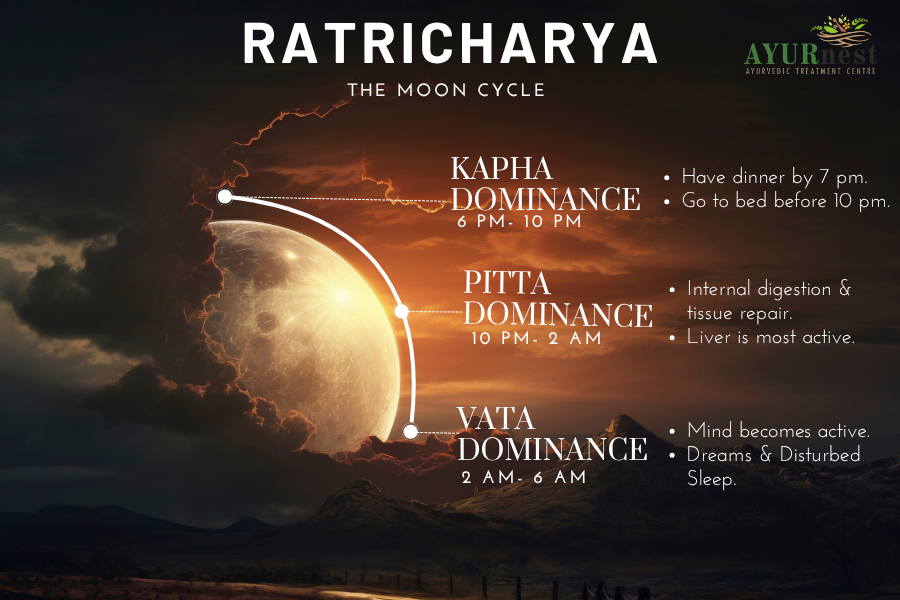
Ayurveda divides the 24-hour cycle based on the tridosha theory (Vata, Pitta, Kapha). Nighttime is not merely for rest-it is a structured biological phase:
| Time | Dominant Dosha | Ayurvedic Insight |
| 6-10 PM | Kapha | Cooling, grounding, sedative forces |
| 10-2 AM | Pitta | Internal digestion & tissue repair, Liver is most active, hepatic cleansing. |
| 2-6 AM | Vata | Mind becomes active; dreams occur; A disturbed sleep during this phase affects mental clarity. |
If you’re awake past 10 PM, you miss the sedative pull of Kapha and enter the phase of internal digestion, while the body is still processing food. The result? Ama, inflammation, disturbed dreams, and fatigue on waking.
Recent studies on circadian medicine (e.g., Panda S., Cell, 2020) have shown that the liver, mitochondria, and immune cells follow rhythmic cycles remarkably similar to what Ayurveda suggests.
The Ayurvedic Ratricharya Ritual: A Step-by-Step Descent into Stillness and Sleep
Step 1: Ahara Samyoga (Night-time Food is More Than Nutrition)
“Aaturanam bhojana kaale hi hitam bhavati”
(Sutrasthana 25/40)
Charaka (Sutrasthana 25.40) emphasizes that food must be consumed at the right time, with the right combinations, and in a state of mental tranquility. The night, being Kapha-pradhana, cannot tolerate guru (heavy), snigdha (oily), or vidahi (irritating) foods. Eating late burdens the digestive fire (Agni) and causes Ama (toxin) formation, which is considered the root of most diseases.
Light Dinner Before Sunset or by 7 PM. An Ayurvedic dinner is not about calorie counting but agni alignment.
Missteps:
- Eating curd at night, which increases Kapha and blocks microchannels (srotas)
- Late dinners, which force food into the Pitta window (10 PM-2 AM), interfering with liver detoxification
- Eating in front of a screen, which is indriya pravritti (sensory overload)
Research alignment:
A 2018 study in The Lancet Diabetes & Endocrinology found that late eating disrupts glucose metabolism which increases insulin resistance and disrupts melatonin rhythms.
Step 2: Shatapavali-(100 Steps After Dinner)
Charaka discusses this practice of walking under “Vyayama” (physical movement) before bed (Sutrasthana 7/32).
A gentle walk after meals, traditionally recommended for aiding digestion, is backed by science. A 2019 meta-analysis in Diabetology & Metabolic Syndrome showed post-meal walking reduces postprandial glucose spikes.
Physiologically, walking helps in:
- Stimulating Samana Vata, which governs digestion
- Preventing nocturnal bloating (adhmana)
Modern studies confirm that even a 10-minute post-dinner walk significantly reduces post-meal glucose spikes.
Step 3: Abhyanga and Padabhyanga
Charaka (Sutrasthana 5.88-89) prescribes abhyanga as a daily ritual, emphasizing its effects on sleep, strength, aging, and skin glow.
But why before bed?
Because oiling, particularly of soles (padabhyanga) and scalp (shiras abhyanga):
- Grounds Vata, the dosha of movement and restlessness
- Nourishes majja dhatu, the nervous tissue
- Induces parasympathetic activation-a calm body invites restful sleep
Sesame oil, rich in linoleic acid and warming by nature, is the oil of choice. However, if your Pitta is aggravated then, use Brahmi or coconut oil.
“Abhyangamacharet nityam…”
(Charaka Samhita Sutrasthana 5/88)
“Daily oil massage bestows good sleep, improved skin, and delays aging.”
Step 4: Nasya (Nasal Oil Application)
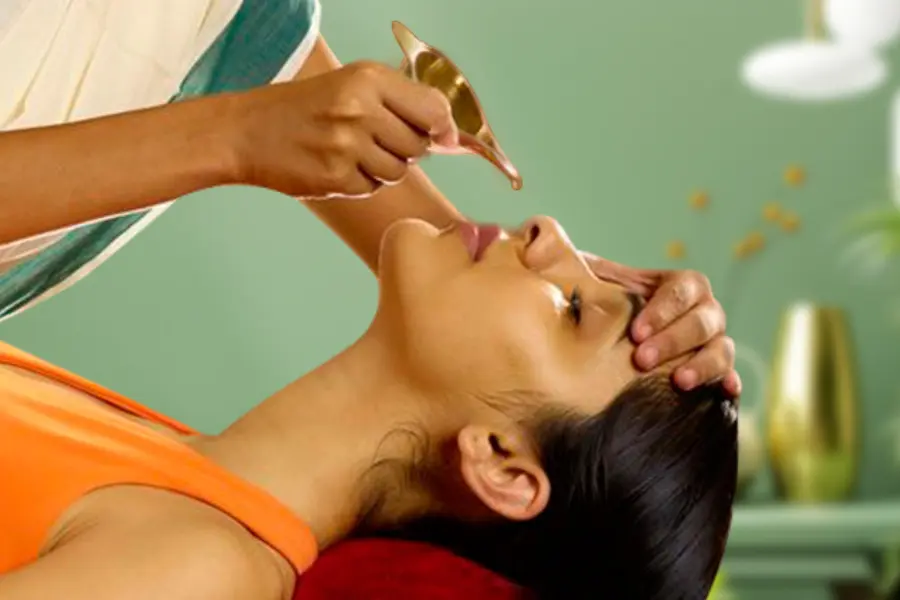
Night Nasya with medicated ghee or Anu Taila is deeply therapeutic. According to Charaka Samhita Sutrasthana 5.56-63, Nasya cleanses the Urdhva Jatru (organs above the clavicle), strengthens senses, and prevents premature aging.
Why at night?
Because the body is moving inward, the doshas are retracting. Nasya ensures that Prana Vata, the most subtle energy of perception, remains clear and lubricated.
Modern research: A 2021 study in Journal of Ayurveda and Integrative Medicine observed that Nasya therapy improves sleep quality in insomnia patients and reduces anxiety.
[Dayal Sitaram Bawankar, Kavita K Daulatkar. Exploring the Efficacy of Nasya Therapy in the Management of Nidranash (Insomnia): An Ayurvedic Perspective. International Journal of Research in AYUSH and Pharmaceutical Sciences, 2024;8(8):6-10.]
Step 5: Digital Detox and Mindful Wind-Down
Blue light exposure after sunset increases cortisol, the stress hormone. Ayurveda never mentions screens, but it clearly warns against “indriya-pravritti” (overstimulation of senses) after sunset.
Suggested wind-down activities:
- Journaling or listening to Shanti mantras
- Reading spiritual texts or classical Ayurveda (e.g., Charaka Samhita Sutrasthana chapters 5-7)
Step 6: Nidra and Swapna-Where Digestion Meets Consciousness
- Ayurveda treats sleep as a phase of digestion-not just of food, but of impressions.
- Charaka lists six types of Nidra, one of which is klama sambhava -sleep born from exhaustion (Sutrasthana 21). But true sleep, he says, is the one that comes from balance (samyak nidra), not fatigue or escapism. Read the different types of Nidra.
- Even dreams (swapna) are described as indicators of doshic imbalance. Vata dreams are chaotic; Pitta dreams are intense; Kapha dreams are often romantic or heavy.
- Left-side sleeping, though not mentioned in Charaka directly, aligns with Ayurvedic anatomy: the stomach is on the left, and gravity aids digestion in this position. Modern findings in The Journal of Clinical Gastroenterology support this with evidence that left-side sleeping reduces acid reflux.
Customizing Ratricharya for Your Dosha Type: Vata, Pitta, or Kapha?
For the Restless One: Vata Prakriti
Vata, governed by air and ether, is quick to fatigue and quicker to awaken. People of Vata constitution often struggle with light, fragmented sleep, anxious thoughts, and a tendency to wake between 2-4 AM: the Vata-predominant phase of the night.
Ratricharya Focus: Grounding, warmth, regularity.
What helps:
- A cup of warm milk infused with a pinch of nutmeg or jatamansi before bed helps quiet the mind and nourish the tissues (dhatus). We know milk at night is debatable, read this article to understand better.
- Daily Abhyanga with sesame oil, particularly on the feet and scalp, calms Prana Vata-the subdosha governing the mind.
- A strict sleep schedule is essential. Vata is easily thrown off by irregularity, so sleeping and waking at the same time each day restores inner rhythm.
For the Sharp-Minded: Pitta Prakriti
Pitta is the fire element in motion-brilliant, intense, and often overstimulated mentally, even when physically tired. Pitta individuals may fall asleep easily but often wake in the middle of the night, especially between 10 PM and 2 AM, when internal fire (Pitta kala) is high.
Ratricharya Focus: Cooling, calming, deactivating the intellect.
What helps:
- A small dose of Brahmi ghee or Shatavari ghee before bed balances mental fire and supports the hormonal axis.
- Incorporate herbs like Shankhpushpi, Guduchi, or Tagara, which pacify overactive Pitta without sedation.
- Avoid spicy, oily, or acidic foods at dinner-even so-called “healthy” ones like tomato soup or fermented pickles. They may aggravate internal heat and delay deep sleep.
For the Heavy Sleeper: Kapha Prakriti
Kapha, ruled by earth and water, naturally leans toward stillness and inertia. While Kapha types may have no trouble falling or staying asleep, they often wake dull, groggy, or sluggish, especially if they’ve overindulged the night before.
Ratricharya Focus: Lightness, stimulation, clearing.
What helps:
- Keep dinner light, warm, and dry in texture-such as a barley soup or lightly sautéed vegetables. Completely avoid dairy at night, especially curd, which increases Ama and Kapha.
- Use sharp, invigorating scents like eucalyptus, clove, or camphor to open the senses before bed.
- A brisk 10-minute post-dinner walk is not optional-it’s essential. Kapha sleep is most rejuvenating when it follows agni activation.
True Ratricharya is not about following a fixed routine, but about aligning your night with your nature.
Don’t know what is dosha? Read this to help you figure out what is your dosha?
Science Meets Samhita: What Research Now Reveals About Ayurvedic Night Rituals
Rather than being ancient superstition, Ratricharya is a brilliant observation of biological rhythms- long before we had EEGs, melatonin studies, or liver enzyme mapping. Modern science, without realizing it, continues to validate the wisdom of the Samhitas.
Let’s take a closer look at how core Ayurvedic night practices mirror the findings of chronobiology, neuroendocrinology, and sleep science:
1. Pitta Kala (10 PM-2 AM) and Liver Detoxification
Ayurveda describes this time as Pitta-dominant, when the body is engaged in internal “digestion”- not of food, but of accumulated toxins, impressions, and emotions.
Modern Parallel:
Research in chronomedicine shows that the liver’s detoxification enzymes peak during this time, especially if the person is asleep. Disruptions here are linked to insulin resistance, poor metabolism, and hormonal imbalance.
Study: Panda S, Cell, 2020 – Liver and gut circadian rhythms.
2. Dinner Timing and Agni vs. Circadian Metabolism
Ayurveda’s warning against late dinners isn’t just about indigestion- it’s about not burdening the body when Agni (digestive fire) is naturally low.
Modern Parallel:
Late eating disrupts glucose tolerance and circadian alignment. A study in The Lancet Diabetes & Endocrinology (2018) confirmed that eating late at night impairs metabolic health, even if calories remain the same.
Study: The Lancet, 2018
3. Abhyanga & Padabhyanga and the Parasympathetic Switch
Oiling the body-especially the soles and scalp-before bed is a signature Ayurvedic practice. It’s not cosmetic-it’s neurological nourishment.
Modern Parallel:
Gentle touch stimulates the vagal nerve, activating the parasympathetic (rest and digest) system, lowering cortisol, and improving sleep onset.
Study: Touch therapy and vagal tone – Frontiers in Psychology, 2020
4. Nasya and Neurological Wind-Down
Nasya, the practice of administering medicated oil or ghee into the nostrils, is said to calm the mind and promote deep sleep.
Modern Parallel:
The olfactory nerve connects directly to the limbic system (which governs sleep, emotions, and hormonal cycles). Nasya likely affects melatonin release through this pathway-especially when using calming herbs like Brahmi, Jatamansi, or Kshirabala taila.
Study: Nasya improves sleep latency – JAIM, 2021
5. Avoiding Screens at Night and Blue Light Melatonin Suppression
Ayurveda encourages indriya nigraha-withdrawing the senses before sleep. Overstimulation of the eyes (chakshu indriya) disrupts the natural descent into Nidra.
Modern Parallel:
Screens emit blue light, which suppresses melatonin and delays circadian sleep signals. Even 1-2 hours of screen use before bed can shift melatonin onset by up to 90 minutes.
Study: Harvard Medical School Sleep Research, 2014
| AYURVEDIC CONCEPT | MODERN EQUIVALENT |
| Pitta Kala detox (10 PM-2 AM) | Liver detoxification cycle during sleep |
| Agni and dinner timing | Circadian metabolism and glucose homeostasis |
| Abhyanga and Padabhyanga | Activation of parasympathetic nervous system |
| Nasya for Nidra | Olfactory influence on limbic brain and melatonin |
| Avoiding screen at night | Blue light suppresses melatonin production |
Common Nighttime Habits That Disrupt Dosha Balance and Sleep Quality
- Eating or drinking late
- Sleeping with a full stomach
- Using heavy screens (TV, phone)
- Skipping Abhyanga or mental calming rituals
- Irregular sleep timing
📚 Classical References
- Charaka Samhita Sutrasthana 5, 7, 21, 25
- Ashtanga Hridaya Sutrasthana 2, 7
- Research sources:
- Journal of Ayurveda and Integrative Medicine, 2021
- Nutrients, 2020 – Circadian Eating
- Diabetology & Metabolic Syndrome, 2019 – Post meal walking
- Journal of Clinical Gastroenterology, 2012 – Sleep posture and reflux
Final Thoughts: Ratricharya in Ayurveda
If you wish to detoxify your body, sharpen your mind, and build long-term immunity, the place to start is not a supplement-but your night routine.
Even if you pick just 2-3 rituals from the Ayurvedic Ratricharya-early dinner, Abhyanga, and digital detox-you will feel a profound shift within weeks.
Let night become your medicine. Let silence become your therapy. Let Ayurveda become your rhythm.
Ready to Begin Your Ratricharya?
At AYURnest, we help you personalize your nightly routine based on your prakriti, current imbalances, and lifestyle.
💠 Explore our Ayurvedic therapies for insomnia and stress
💠 Consult our doctors for a constitution-based sleep protocol
💠 Experience the calming effects of Abhyanga, Nasya, and Shirodhara—rituals that deepen Nidra the Ayurvedic way
👉 Book your consultation today or visit us at AYURnest, Kankurgachi, Kolkata.
Prefer a quick tip? DM us on Instagram @theayurnest with your concern and get Ayurvedic advice tailored to you!